Posts

World Water Day 2022: Groundwater

Image
  World Water Day, on 22 March every year, is about focusing attention on the importance of water. This year’s theme, groundwater, draws attention to the hidden water resource that has always been critically important but not fully recognized in sustainable development policymaking. Under the title “Groundwater – Making the invisible visible” , this year’s campaign will explain groundwater’s vital role in water and sanitation systems, agriculture, industry, ecosystems and climate change adaptation. The overarching message of the campaign is that exploring, protecting and sustainably using groundwater will be central to surviving and adapting to climate change and meeting the needs of a growing population. Learn more about the World Water Day 2022 campaign here .

The Water Nexus Games - The Water Rooms #3:

Image
The interconnections between water, energy, food and environment are like a board game where, to win, all the players need to gather as many resources as possible. Will we be able to change the rules to reach the common good? The 3rd movie of "The Water Rooms" is a journey into the world of freshwater resources. The film was made by WWAP UNESCO .

Where is Water? - The Water Rooms #2

Image
Did you know that each person uses 300 liter water every day in developed countries? And did you know that the majority of freshwater is actually hidden underground? These, and many other questions will be answered in the second part of the 3-part video series of The Water Rooms, which is “Where is Water?” The film is animated by famous English illustrator and animator Steve Cutts. His artwork satirises the excesses of modern society. The film was made by  UNESCO WWAP .

The Hydrological Cycle - The Water Rooms #1

Image
We would like to draw your attention to a 3-part video series of The Water Rooms . The first video takes us into the wonderful world of the water cycle . The environment is in the center of the water cycle and it is an integral part of all aspects of water management. All water originates from the environment that surrounds us and returns there with the impurities made by humans. Let’s dive under and over the water! The film was made by UNESCO WWAP .

Book recommendation: "Wally & Deanna's Groundwater Adventure... to the Saturated zone"

Image
"Wally & Deanna's Groundwater Adventure... to the Saturated zone" is a great book to teach kids about the water cycle and groundwater, now available in Hungarian as well. We promise you and the kids will have a lot of fun while learning!  Download the book here:  https://cutt.ly/WD_Hungarian Watch the full interview with  Judit Deri-Takacs  about the process of translating a children’s book about hydrogeology! 

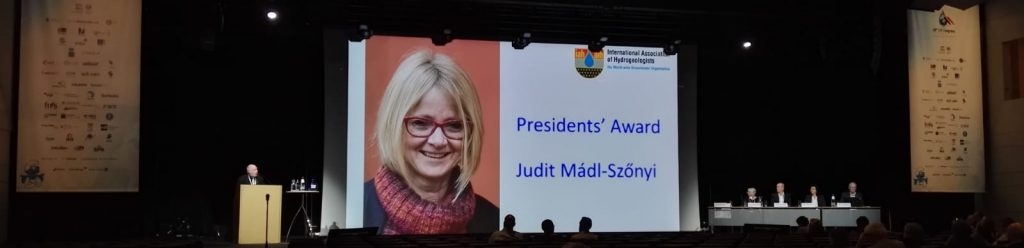
IAH Presidents' Award

Image
This year Judit Mádl-Szőnyi , the scientific coordinator of ENeRAG received one of the most prestigious awards of the International Association of Hydrogeologist (IAH), the IAH Presidents’ Award . It can be considered as a huge success, as this is the first time that a specialist working in Hungary was awarded this recognition.  The IAH Presidents’ Award was established in 1995 and is determined by the current and past presidents. It is given annually to a member who has made outstanding international contributions to groundwater science and furthering IAH’s mission to promote understanding and management of groundwater resources for the benefit of humankind and the environment. Judit Mádlné Szőnyi was selected for this award for her outstanding and high-level international work in understanding and disseminating groundwater flow systems. The award also honors the work she has done as head of the IAH Groundwater Flow Commission. It also qualifies the results of the so-called ‘Toth...

New Book - The Lands of Karst

Image
We would like to draw your attention to a new book that introduces to the amazing underground world, the environment of caves and karst formations. This book is called “The Lands of Karst: A Visual Story” which comprises around 500 nice photographs as a contribution to the 2021 - International Year of Cave and Karst declared by the International Union of Speleology and supported by UNESCO and numerous institutions and organizations. The colour photographs are from six Lands of Karst of ex-Yugoslavia - Slovenia, Croatia, Bosnia and Herzegovina, Serbia, Montenegro, and North Macedonia, which had been recorded by more than 70 geologists, speleologists, biologists, archaeologists, mountaineers, professional photographers or simply amateurs - karst and caves lovers. The authors, Neven Kresic and Zoran Stevanovic by following the rule “a picture is worth a thousand words” prepared very short informative texts for 10 chapters featuring photographs of noisy rivers, wild mountains, silent l...

ENeRAG H2020 Twinning project – an opportunity for mutual growth

Image
The ENeRAG project started to run from 1 October 2018 through the cooperation of Eötvös Loránd University (ELTE) , University of Milan (UMIL) and Geological Survey of Finland (GTK) and support of external partners. The aim is to upgrade the expertise of ELTE in the fields of geofluids through an innovative approach that relates diverse aspects of geofluids application. Geoenergy, groundwater and hydrothermal minerals are the three main pillars around which expertise can grow.  The project had planned plenty of activities: student exchanges, short courses, field courses, as well as participation and organization of events.    Plans got affected by the spread of the pandemic and with it the project got an unexpected twist in its realization. In a phase where face-to-face happenings had not been possible, the best emerged from the worst. We all learned to use remote meeting tools. Having all to face basic challenges in the same periods brought up an innovative spirit whil...

Neptunus and the world without water

Image
 

CHARM-EU Podcast with Ádám Tóth

Image
CHARM-EU represents a Challenge-Driven, Accessible, Research-based and Mobile model for the co-creation of a European University aligned with the European Values, the European Green Deal and the sustainable development goals (SDGs). The CHARM-EU is an initiative formed by five research-based universities (University of Barcelona, Trinity College Dublin, Utrecht University, Eötvös Loránd University Budapest (ELTE) and University of Montpellier) which was created to become a world example of good practice to increase the quality, international competitiveness and attractiveness of the European Higher Education landscape. Sustainability is a complex issue with a diverse set of challenges we must face. The CHARM-EU Master’s in Global Challenges for Sustainability allows students to choose between three of the most crucial elements of sustainability in the flexible phase of the course: Water, Food, Life & Health. Podcast episode was released with Ádám Tóth , ELTE-ENeRAG project fell...

“World Water Day 2021: Valuing Water”

Image
Celebrate World Water Day on March 22nd ! On this occasion, the IWRA (International Water Resources Association) invites those interested to a webinar entitled “World Water Day 2021: Valuing Water”. The theme of World Water Day 2021 is focused on “Valuing Water“ .  Beyond the economic issues, this topic includes also the environmental, social and cultural value people place on water. With water resources facing increased pressure, understanding the many different and competing ways to value this unique resource becomes a key way to help equitably balance competing demands and interests, and reach sustainable responses worldwide today, and for many generations to come. In preparation for these webinars, access the United Nations World Water Development Report 2021 to learn more about this topic! The program of the webinar has two parts: one in the morning (9AM - 10:30 AM) and one in the afternoon (3 PM - 4:30 PM). During the morning you can listen to professional discourse on the...

Budapest Inferno - The secret of Molnár János Cave

Image
History of Molnár János Cave: Under the thriving metropolis of Budapest, only meters from the Danube’s riverbanks, lies an underground wonder: the submerged Molnár János Cave , Europe’s largest underwater  active thermal water cave. Deep thermal karst waters are responsible for the formation of the cave, which is still actively forming, albeit very, very slowly. In the 19th century, János Molnár, a pharmacist , investigated the dry section of Molnár János cave. He also analysed the health benefits of the spring water that feeds Malom Lake, at the entrance of the cave. Based on his results, he concluded that there is a huge underwater cave system beyond the known section of the cave. The underwater exploration started in the 1950s, and  divers successfully explored and charted more than 400 meters of the Molnár János cave system only in the 1970s and 1980s. Then, in 2002, divers found a new passage . The new part was considerably larger, with the biggest charted hall over 80 me...

International Year of Caves and Karst - Movie released

Image
The International Year of Caves and Karst (IYCK) is a series of events organized by the Union Internationale de Spéléologie (UIS) , an international organization of 55 member countries. Caves and karst occur around our planet but few people understand the great value of caves to humanity. Even fewer know what karst is. By 2021, UIS has launched a global project with the ultimate goal of introducing as many people as possible to these critical and multifaceted natural resources. „Explore, understand and protect“ is the main goal of the IYCK. The virtual opening ceremony of the IYCK took place on the 26th of January. In addition to the video of the opening ceremony, you can also watch a 6 minute long video showing some of the most beautiful examples of karst and caves in the world and explaining why their protection is important. You can watch the video here: International Year of Caves and Karst MOVIE If you are interested in more videos during the year visit the event’s YouTube Channe...

About Natural Water Retention Measures (NWRM) in general

Image
Climate change affects local communities around the world. The dangers are manifested in various extreme events, but the most common problem is caused by a lack or excessive amount of water. As a result of climate change the average temperature is expected to increase with 3-5 °C in Hungary. Periods of water shortage and drought are increasing, while raining is becoming more unpredictable and intense, causing worsening flood and inland water problems. Natural approaches have an important role to play in protecting water resources and addressing the risks associated with climate change. Source:  http://nwrm.eu/hydro-morphology Source:  http://nwrm.eu/hydro-morphology Adaptation practices related to water management, which are based on the use of natural processes and ecosystem services, are called  Natural Water Retention Measures  (NWRM). As natural water retention solutions are considered a “powerful” adaptation option, their encouragement and support is widely des...

Online Conference IWRA 2020

Image
The IWRA (Inter national Water Resources Association) organized a free and online conference entitled “Addressing Groundwater Resilience under Climate Change” on October 28-29-30 2020. “Currently, climate change has become an undeniable major pressure on the world’s freshwater resources. Yet, the effects of climate change on groundwater, the most significant freshwater resource on Earth, are still poorly understood.”  The conference offered a special opportunity to share research results about the effects of climate change on natural groundwater resources, groundwater pollution and remediation, the available technology for that, and highlighted the importance of governance, management, policy and education as well. Among others, Managed Aquifer Recharge and its role in climate change adaptation was introduced, which is one of the main topics of ENeRAG. After the presentations, questions and answers could be discussed which promoted scientific knowledge exchange and gave new ide...

International Water Conference: SEFS, July 25-30, 2021

Image
  The Symposium for European Freshwater Sciences (SEFS) is one of the most important international water conferences held every two years in various European cities. This year, Dublin undertook to organize, but due to the COVID-19 pandemia, the event would be held online from July 25-30, 2021. You can register now for the virtual conference: registration (early bird)

Sprinkled Like Paprika, The Thermal Waters of Hungary

Image
Susan Fox Hodgson , from the US, associate of the Geothermal Resources Council (GRC) came from California to Hungary to see water conditions of the country. She has visited Hungary personally, met some Hungarian hydrogeologist and geophysical experts to get to know the Hungarian thermal waters and wells. Based on her research and conversation with the experts wrote the material titled as “Sprinkled Like Paprika, The Thermal Waters of Hungary” , published in the GRC BULLETIN June 2020. The hole study is available  here . Source: Susan Fox Hodgson: Like Paprika, The Thermal Waters of Hungary

Karst Aquifer Resources availability and quality in the Mediterranean Area (KARMA) - SURVEY

Image
The KARMA project is a cooperation of (karst)-groundwater scientists from seven countries under the umbrella of the PRIMA initiative . The objective of the KARMA project (2019-2022) is to achieve substantial progress in the hydrogeological understanding and sustainable management of karst groundwater resources in the Mediterranean region in terms of water availability and quality at different scales. The project is coordinated by Prof. Dr. Nico Goldscheider from the Karlsruhe Institute of Technology (KIT), Germany. For more information visit the website: www.karma-project.org In the framework of the project, the KARMA survey is carried out in order to obtain a comprehensive picture of how the regional experts assess the importance of the tools for improved karst groundwater management developed in the KARMA project: • Modeling tools • Vulnerability maps • Early warning systems (EWS) for groundwater contamination • Mediterranean Karst Aquifer Map and database (MEDKAM) Comments and eval...

Water cycle 2.

Image
In the previous post you could read about where the Earth’s water resources can be found and how much time water spends in the spheres. Now, you can find out which natural interactions are responsible for water movement between the different spheres. The Water Cycle Source: https://www.usgs.gov/special-topic/water-science-school/science/fundamentals-water-cycle?qt-science_center_objects=0#qt-science_center_objects Water cycle is generated by energy arriving from the Sun. On the extensive free surface of seas and oceans water easily starts to evaporate and get into the atmosphere due to solar radiation. We can see the same process on a smaller scale on the surface of lakes and rivers or ice and snow caps. Not only the physical evaporation but also plants can transport water (mostly shallow groundwater, infiltrating rainwater) to the atmosphere. This is called transpiration . When the air becomes saturated by vapour, water condenses and cloud formation starts. This is usually caused by ...

Water cycle

Image
What would we see if we followed a drop of water for a day, a year, or a decade? How many phase transitions would happen? How much time would it spend at the same sphere? Which natural processes would it take part in? To answer these questions, let’s see the water cycle in this post. Water cycle Source: https://www.sciencelearn.org.nz/resources/721-the-water-cycle The Earth is a closed hydrological system which means that there’s a constant amount of water on the planet for millions of years. However, water is always in motion . It moves in different phases between the 3 large reservoirs of the Earth: atmosphere, lithosphere, and hydrosphere. This one-way periodic circulation is the system of water cycle . The circulation is generated and sustained by the energy from the Sun and it’s based on the principle of minimum energy. In the 3 spheres water is present in different states for different periods of time. The least water, less than 0.01% of the total amount, is stored in the atmosp...